

How to Style a Small Apartment: A Cozy 2026 Guide
Table of Contents
- Start With a Floor Plan and a Clear Vision
- Space Saving Furniture for Small Apartments That Actually Works
- How to Decorate a Small Living Room on a Budget
- Apartment Friendly Wall Decor That Adds Depth
- Lighting Techniques That Make Small Rooms Feel Bigger
- Rental-Friendly Modifications and Eco-Friendly Choices
- Common Styling Mistakes to Avoid in a Small Apartment
- Frequently Asked Questions
Last Updated: September 14, 2026
Start With a Floor Plan and a Clear Vision
Learning how to style a small apartment starts with a floor plan, not a shopping cart. A scaled drawing showing furniture, doors, windows, and walkways is the single most useful tool for making a compact space work.
Here is how to build one in an afternoon:
- Measure every wall, doorway, and window with a tape measure, and note the ceiling height.
- Sketch the layout on graph paper, or drop the measurements into a free floor plan app.
- Mark fixed obstacles: radiators, outlets, air vents, and how far each door swings open.
- Block out your furniture in scale, allowing at least 18 inches of walkway between pieces (ADA Standards for Accessible Design Title III Regulation 28 CFR Part 36 (1991)).
- Map your daily path from bed to bathroom to kitchen, and protect that route.
That last step is where most plans fall apart: a layout can look balanced on paper and still feel cramped when you squeeze past a coffee table every morning.
Measure Everything Before You Buy
The biggest mistake is buying furniture that fits the room but not the life inside it. Measure twice, including the diagonal; a sofa that clears a doorway head-on can jam once you tilt it.
Keep three numbers per wall on your phone: length, usable length after obstructions, and the width of the tightest doorway the piece must pass through. If a piece does not clear all three, it is not a bargain at any price.
Pick a Cohesive Color Palette
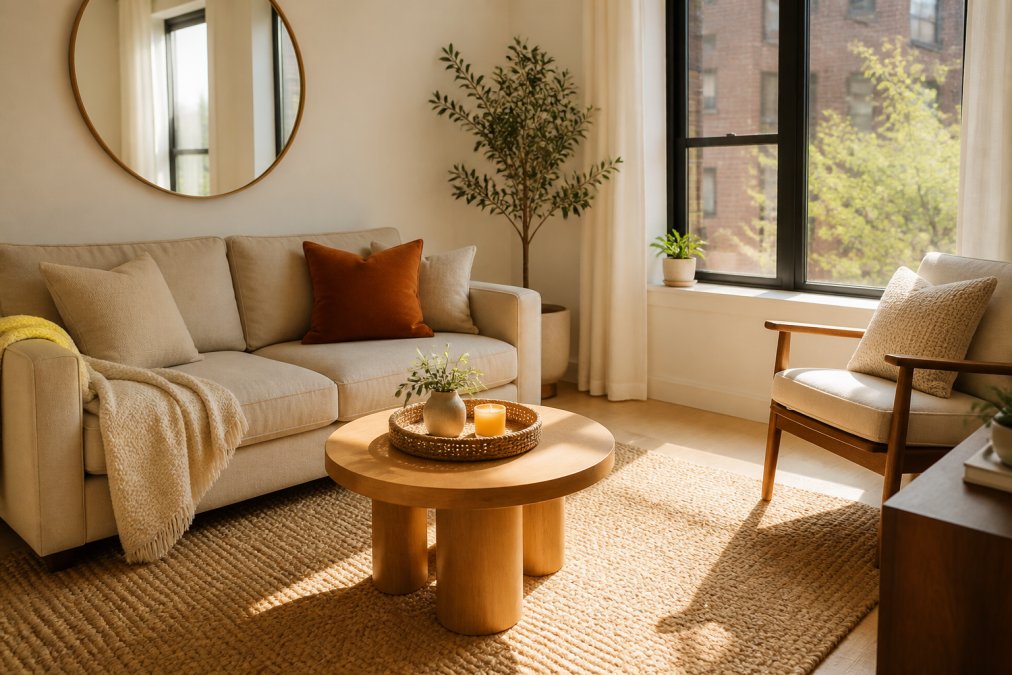
A cohesive color palette is two to three core colors plus one accent, repeated across walls, textiles, and furniture so the eye reads the whole apartment as one room.
A neutral palette does the heavy lifting: warm whites, soft beiges, and muted greens keep walls from closing in, while one deeper accent (a rust cushion, a navy throw) adds weight without shrinking the room. Test samples at three times of day; a shade bright at noon can turn muddy under evening lamps.
Space Saving Furniture for Small Apartments That Actually Works
Space saving furniture for small apartments works because it multiplies function per square foot, not because it is smaller. The pieces that earn their place do two jobs: a bed that lifts to reveal storage, an ottoman that seats two and swallows blankets, a desk that folds flat against the wall.
One well-chosen multifunctional piece replaces three, freeing floor space and money.
| Piece | Job One | Job Two | Best For |
|---|---|---|---|
| Storage ottoman | Seating | Blanket and linen storage | Living rooms under 120 sq ft |
| Nesting tables | Coffee table | Side tables for guests | Studios with one seating zone |
| Wall-mounted desk | Workspace | Vanity or entry catch-all | Tiny home offices |
| Under-bed drawers | Bed frame | Off-season clothing storage | Bedrooms with no closet |
| Modular sofa | Seating | Reconfigured for movie nights | Open-concept layouts |
Multifunctional Pieces and Hidden Storage
Hidden storage is the quiet hero of a small apartment: under-bed bins hold off-season clothing, wall-mounted shelves replace floor lamps and side tables, and a lift-up bench hides shoes at the entry.
The rule I follow: if a piece does not store something or seat someone, it needs a very good reason to stay.
Vertical Storage and Wall-Mounted Solutions
Vertical storage is the fastest way to reclaim a cramped room because it uses height instead of floor area. Floor-to-ceiling shelving, hooks behind doors, and floating shelves pull clutter off surfaces and into the air.
A common mistake is stopping at eye level. The top two feet of a wall are almost always wasted, exactly where baskets of paperwork, spare linens, and seasonal decor can live out of sight.
How to Decorate a Small Living Room on a Budget
The best way to decorate a small living room on a budget is to spend on the pieces you touch daily and save on the ones you only look at. A comfortable sofa and good lighting change how a room feels; a trendy vase does not. In a rental, ask what you can change without losing your deposit and what will still work when you move.
Start with what you already own: pull every piece into one room, remove anything that does not earn its footprint, and let what remains become your shopping list.
Budget-friendly moves that actually work:
- Rearrange before you replace; a new layout costs nothing.
- Shop secondhand for solid wood tables and lamps, which hold up better than flat-pack.
- Layer affordable textiles (throws, cushion covers, curtains) to change a room's mood for less than the cost of new furniture.
- Repaint one accent wall instead of the whole room, or, if you rent, use peel-and-stick wallpaper on a single wall.
- Swap hardware, not furniture: new cabinet knobs and drawer pulls cost a few dollars each and read as a full refresh.
Rental-Friendly Budget Upgrades That Come Back Off
If you cannot drill, you can still style. Tension rods fit inside window frames and doorways for curtains and closet dividers with zero holes. Removable adhesive hooks and picture-hanging strips hold lightweight frames and small plants. Peel-and-stick wallpaper and removable tile backsplash sheets transform a kitchen wall or bathroom vanity and pull away clean. A freestanding bookcase on casters adds storage without anchoring to a wall.
The trade-off is real: removable products cost more per square foot and have weight limits. Adhesive strips are rated by the pound, so check the package before hanging anything heavier than a small frame. For anything heavy, anchor into a stud or use a tension-mounted system.
Ergonomics for a Tiny Home Office Corner
If you work from home, the living room often doubles as the office. A productive corner needs three things: a surface at the right height, a seat that supports your back, and light that does not glare off a screen.
A wall-mounted or folding desk keeps the floor clear when you are off the clock. Pair it with an adjustable chair rather than a dining chair; the back support is the difference between a two-hour session and a six-hour one. Position the desk so a window is to your side, not behind or in front of the screen, and add a task lamp with an adjustable bulb. When the workday ends, fold the desk, tuck the chair, and the corner returns to living space.
Rugs, Textiles, and Layering for Less
Choosing the right rug size is the most common budget mistake in small living rooms. A rug that is too small makes a room feel disjointed; the front legs of your sofa and chairs should sit on the rug, not float beside it.
Apartment Friendly Wall Decor That Adds Depth
Mirrors, Gallery Walls, and Rental-Safe Hanging
Lighting Techniques That Make Small Rooms Feel Bigger
Rental-Friendly Modifications and Eco-Friendly Choices
A Rental Modification Checklist
Before you buy, run each idea through four questions:
Eco-Friendly Choices That Also Save Money
EPA guidance on indoor air quality and low-VOC products
Common Styling Mistakes to Avoid in a Small Apartment
Watch for these:
Frequently Asked Questions
What is the 3-5-7 rule in decorating?
The 3-5-7 rule is a styling guideline for arranging accessories in odd-numbered groups: three small items, five medium items, and seven tiny items. The idea is that odd numbers create visual balance and prevent a shelf or coffee table from looking cluttered. In a small apartment, this rule helps you avoid over-styling tight surfaces. Group a trio of candles on a side table, five books on a shelf, and seven small objects on a tray, then step back and edit anything that feels crowded.
What are the best colors to make a small apartment feel bigger?
Light, neutral color palettes reflect natural light and make walls feel further apart. Soft whites, warm beiges, and pale grays work well as a base, while a single accent wall in a deeper tone adds depth without shrinking the room. Keep large furniture pieces in similar tones to reduce visual weight. If you love color, use it in textiles like pillows, throws, and rugs that you can swap seasonally without repainting.
How do I choose space saving furniture for small apartments without sacrificing style?
Look for pieces that serve two purposes: an ottoman with hidden storage, a wall-mounted desk that folds down, or a sofa bed for guests. Measure your floor plan first so you know exactly what fits. Choose modular furniture that can be reconfigured as your needs change, and prioritize vertical storage like tall bookcases and floating shelves. Neutral upholstery and clean lines keep multifunctional pieces from feeling bulky, and you can add personality through textiles and apartment friendly wall decor.
How can I decorate a small living room on a budget without it looking cheap?
Focus on scale and proportion instead of price. A correctly sized rug, usually one that leaves a border of floor visible, anchors the seating area and makes the room look intentional. Layer affordable textiles like throws and pillows for warmth, and use ambient lighting from floor lamps and string lights to soften harsh overhead bulbs. Thrifted or vintage accent pieces mixed with a few new items create a collected look. Decluttering is free and instantly makes any space feel more expensive.